Fifty Cents and a Frying Pan: The Concession Model Keeping African Clubs Solvent Without a Cable Check
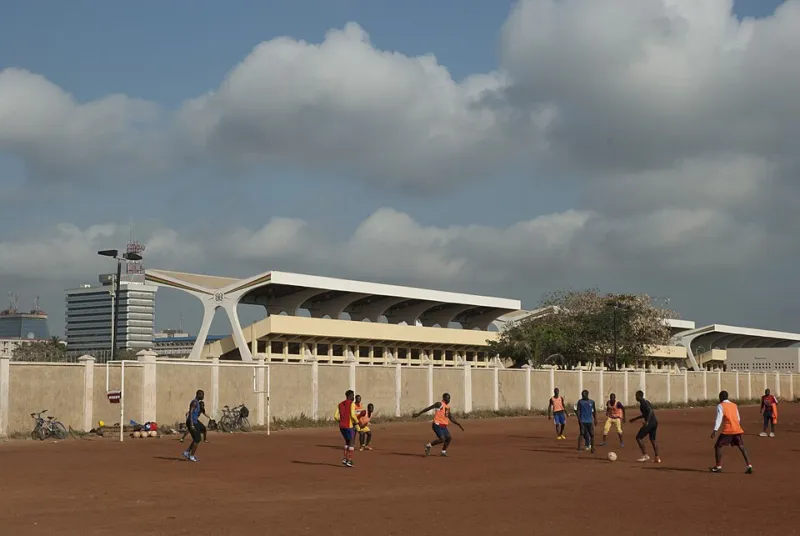
Photo: Ed Suter, CC BY-SA 4.0, via Wikimedia Commons
Walk the concourses outside a matchday ground in Lagos, Accra, or Nairobi and you will not find a concessionaire with a point-of-sale terminal. You will find Aunty Grace and her charcoal grill, a boy selling bottled water from a cooler, and a man doing brisk trade in replica scarves that cost him two dollars and sell for four. The club's cut may be fifty cents here, a naira share there. Multiply it by thirty thousand fans, and the math starts to look less like charity and more like a business model.
The Volume Machine Behind the Turnstile
The stereotype of African club football as a money pit obscures a quieter truth: for a meaningful number of clubs, the balance sheet survives precisely because per-unit pricing is microscopic. Where a Major League Soccer club might need 8,000 paying customers to break even on a home fixture, clubs across the continent structure their entire matchday operation around thousands of micro-transactions instead of a few hundred large ones.
The logic is straightforward. A ticket priced at the equivalent of fifty cents does not cover a stadium's costs on its own. But every one of those fifty-cent tickets puts a fan inside the perimeter — inside the fence, past the informal vendor line, within reach of the jersey seller, the snack stand, and the club-branded kiosk. The ticket is not the product. The ticket is the entry fee to a marketplace.
American sports economics works in the opposite direction. The average fan spend at an NFL game has climbed past $150 when tickets, parking, and concessions are tallied, and franchises have responded by building fewer, richer experiences: clubs, suites, all-inclusive seating. The assumption is that revenue per attendee must rise. The African model assumes the reverse — that attendance must rise, and revenue per attendee can stay almost embarrassingly low.
Informal Vendors, Formal Revenue
The most underexamined piece of this system is the vendor arrangement. Across African leagues, clubs rarely operate their own food and merchandise stands. Instead, they license access — sometimes formally, often through negotiated community arrangements — to local traders who work the stadium perimeter and, in many venues, the aisles themselves.
The club collects a daily or seasonal fee, a percentage of sales, or simply rents space by the square meter. It requires no capital expenditure, no inventory risk, and almost no payroll. A club that cannot afford a catering contract can still monetize thirty vendor spots at a modest fee each. The vendors, in turn, get access to a guaranteed crowd that shows up on schedule twenty or thirty times a season.
It is, structurally, closer to a farmers market than to a stadium concourse. And it solves a problem American minor-league operators know well: the cost of staffing and stocking concessions can eat the margin on cheap tickets. The informal model outsources all of that risk to entrepreneurs who know their customers by name.
What the US Market Could Learn
There is an obvious objection. American franchises do not need micro-transactions; they have media rights, and media rights dwarf everything. But that objection weakens the further down the pyramid you look.
Consider the economics of a USL Championship club, a minor-league baseball franchise, or an NWSL team outside the top markets. These operations face a version of the African problem: limited broadcast revenue, thin corporate sponsorship, and a fan base that is price-sensitive. Their instinct has been to mimic the premium model — build the beer garden, install the party deck, chase the group-sales market. The results are mixed, and the capital costs are not.
The African alternative suggests a different sequence. Price the gate low enough that attending is not a financial decision. Let the community supply the food, the merchandise, and even the atmosphere — drum lines and supporters' brigades are, in their way, unpaid entertainment infrastructure. Then monetize the aggregation: vendor fees, small sponsorships layered onto the crowd itself, and club-branded items sold at price points that match the neighborhood, not the league.
A few American operators have stumbled toward this without naming it. Independent baseball clubs that host $1 ticket nights routinely report their best concession margins of the season, because the crowd that shows up for cheap tickets still buys hot dogs. The African model simply runs that logic every week, rather than as a promotion.
The Limits of the Model
Honesty requires the caveats. Volume economics cap out quickly. A club earning the equivalent of a few thousand dollars per matchday from gate and vendor fees cannot compete in a transfer market where a single mid-tier European move now clears eight figures. This is why the continent's biggest clubs — Al Ahly, Zamalek, the Moroccan and Tunisian giants — have spent the last decade pushing toward broadcast deals, sponsorship tiers, and continental competition revenue that look far more familiar to an American audience.
There is also a governance question. Informal vendor arrangements live and die on relationships, and a change of club leadership can unwind in a week what took years to build. Formalizing those agreements — without pricing the vendors out — is one of the more interesting operational challenges facing African league administrators.
A Different Definition of Fan Value
The deeper lesson is not that American franchises should sell fifty-cent tickets. It is that the industry's definition of fan value has narrowed to the point where it excludes most of the world. In the African model, the fan is not a revenue-per-head metric to be maximized. The fan is the crowd, and the crowd is the asset — the thing that makes a vendor pay for a spot, a sponsor pay for a board, and a fifty-cent ticket worth printing.
US sports business has spent twenty years perfecting the art of extracting more from fewer people. The grounds of African football, with their frying pans and their micro-transactions, demonstrate the opposite discipline: sustaining more people on less. For any American operator outside the premium tier, that may be the more relevant playbook.